Saturday, 18 May 2013

Celtic Eras ( Hallstatt , La Tene )

Hallstatt

Timespan: 1200 BC - 475 BC

"Hallstatt culture is characterised in 4 stages, according to James(2005: 21): A & B late Bronze Age, from c 1200 to 700 BC; C Early Iron Age, from c700-600 BC; D from c 600 to 475 BC"

Map - Hallstatt and La Tène cultures


This culture lived throughout central Europe its center being an area around Hallstatt in Central Austria. During the beginning of the period trade had already been established . They had access to tin and copper (the base materials of copper) also had access to salt which was used to preserve food. These helped the culture to grow and prosper from the beginning. In 800 BC during burial excavations wheeled wagons and iron swords were found.
. Hallstatt burial site, a collection of 19th century watercolours. Page with names of the persons present at the discovery of the site. Johann Georg Ramsauer began the excavation of the 980 tombs in 1846. Drawing of the tombs by Isidor Engel in 1878.
Hallstatt burial site, a collection of 19th century watercolours. Page with names of the persons present at the discovery of the site.


In 700-600 BC fortified settlements were founded in the north of the Alps. Burial mounds were found in these settlements containing expensive items at the time such as vehicles and imported treasures.

During the last period Hallstatt burial grounds were closer on more major hill forts in the southwest region . this implies that there was that wealth and social power was focused on this area.


Hallstatt Findings

Hallstatt artefact
Celtic German Craftsmanship
Hallstatt amber necklace
File:Linz Schlossmuseum - Uttendorf Halsreifen.jpg
Golden neck ring from Uttendorf, Hallstatt culture, ca. 550 BC.
Hallstatt bronze ‘tool’
Bronze Tool

Hallstatt Designs

Gives of the primitive feeling as it cotains a great deal of geometric design. Built on maze like design and repeated patterns


Sources:

Aon Celtic Art. 2013. Aon Celtic Art. [ONLINE] Available at: http://www.aon-celtic.com/trade_history_meanings.html. [Accessed 18 May 2013].

File:Linz Schlossmuseum - Uttendorf Halsreifen.jpg - Wikipedia, the free encyclopedia. 2013. File:Linz Schlossmuseum - Uttendorf Halsreifen.jpg - Wikipedia, the free encyclopedia. [ONLINE] Available at:http://www.en.wikipedia.org/wiki/File:Linz_Schlossmuseum_-_Uttendorf_Halsreifen.jpg. [Accessed 18 May 2013].

Lessing Photo Archive - Hallstatt burial site, a collection of 19th . 2013.Lessing Photo Archive - Hallstatt burial site, a collection of 19th . [ONLINE] Available at: http://www.lessing-photo.com/dispimg.asp?i=070101+3+&cr=79&cl=1. [Accessed 18 May 2013].

How old is English?. 2013. How old is English?. [ONLINE] Available at:http://www.proto-english.org/l41.html. [Accessed 18 May 2013].

The Iron Age in Europe. 2013. The Iron Age in Europe. [ONLINE] Available at: http://archaeology.about.com/b/2011/03/20/the-iron-age-in-europe.htm. [Accessed 18 May 2013].

Tours: The World of Ancient Art. 2013. Tours: The World of Ancient Art. [ONLINE] Available at: http://www.waa.ox.ac.uk/XDB/tours/europe3.asp. [Accessed 18 May 2013].

Celts - Hallstatt and La Tene cultures. 2013. Celts - Hallstatt and La Tene cultures. [ONLINE] Available at: http://celts.etrusia.co.uk/celtic_cultures.php. [Accessed 18 May 2013].

La Tene

Timespan: C 500 BC To C 15 BC


During this period the Celts started to venture out of their borders, expanding and migrating. Named after the location in which they were first discovered being a site in  Switzerland. 


Map - Hallstatt and later La Tène cultures


"France to Bohemia, the La Tene culture spread rapidly from about 400 BC. The La Tene Celts settled in Spain in 450 BC, in Northern Italy in 400 BC, invaded Rome in 390 BC, invaded Greece in 279 BC, invaded Galatia (in modern Turkey) in 270 BC. By 200 BC, they occupied the lands that are now Britain, the Netherlands, Brittany, Belgium, Germany and Switzerland."

This period was more focused on military might rather than cultural expansion. Weapons and armor were as commonly found as the jeweler and other everyday items.

La Tene Findings

“Strettweg Cart” (7th century BCE), found in southeast Austria, a four-wheeled cart with a goddess, riders with axes and shields, attendants and stags. (Landesmuseum Johanneum, Graz, Austria)
Strettweg Cart


A 1st century BCE mirror found in Desborough , Northants, showing the spiral and trumpet theme.
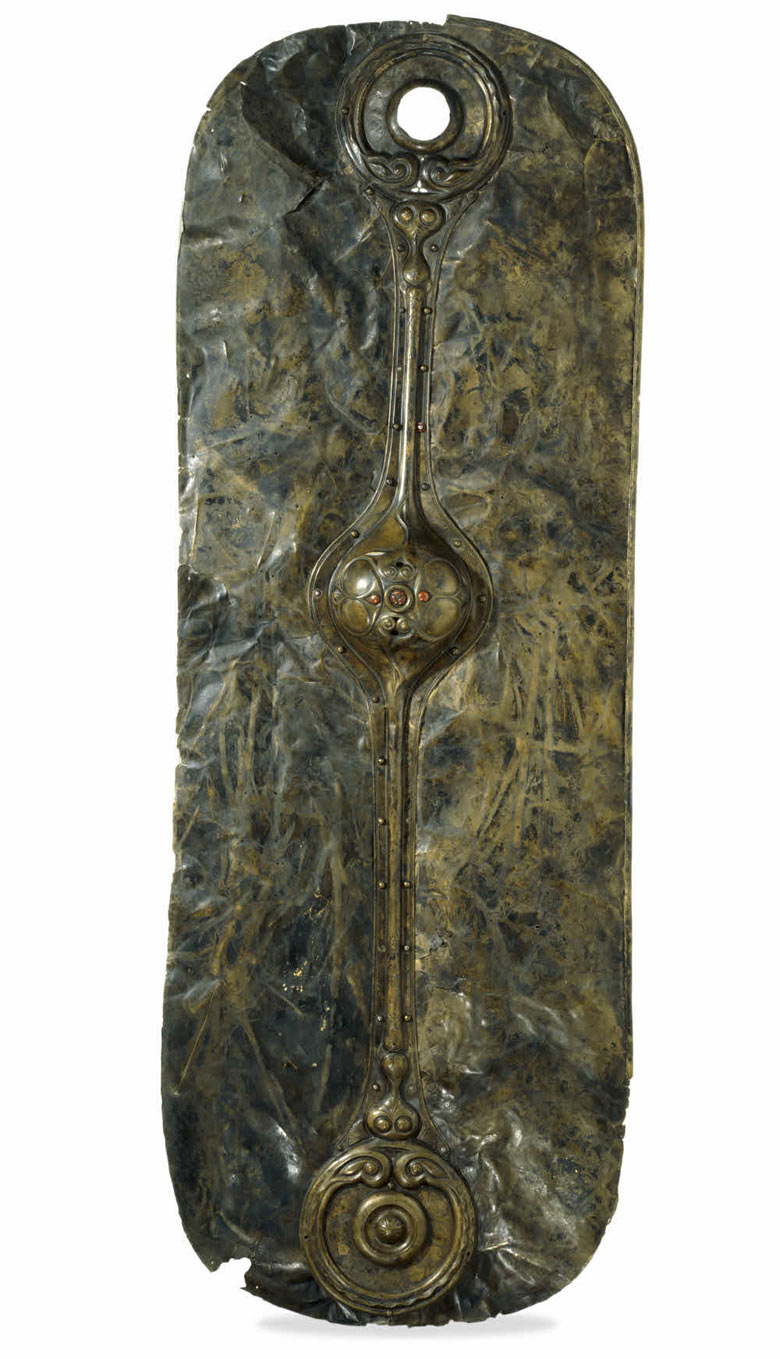
Witham Shield
Witham Shield


The Turoe Stone
Turoe Stone

La Tene Design

 A Grate amount of spirals and leaf shaped design implemented in the work. Extreamly organic and animals and faces could appear depending on the view point.


Sources: 

Aon Celtic Art. 2013. Aon Celtic Art. [ONLINE] Available at: http://www.aon-celtic.com/trade_history_meanings.html. [Accessed 18 May 2013].

Celts - Hallstatt and La Tene cultures. 2013. Celts - Hallstatt and La Tene cultures. [ONLINE] Available at: http://celts.etrusia.co.uk/celtic_cultures.php. [Accessed 18 May 2013].

Tours: The World of Ancient Art. 2013. Tours: The World of Ancient Art. [ONLINE] Available at: http://www.waa.ox.ac.uk/XDB/tours/europe3.asp. [Accessed 18 May 2013].

La Tène culture - Wikipedia, the free encyclopedia. 2013. La Tène culture - Wikipedia, the free encyclopedia. [ONLINE] Available at:https://en.wikipedia.org/wiki/La_T%C3%A8ne_culture. [Accessed 18 May 2013].

“Strettweg Cart” (7th century BCE), found in... - Fuck Yeah Vikings & Celts!. 2013. “Strettweg Cart” (7th century BCE), found in... - Fuck Yeah Vikings & Celts!. [ONLINE] Available at:http://fuckyeahvikingsandcelts.tumblr.com/post/14657877699/strettweg-cart-7th-century-bce-found-in. [Accessed 18 May 2013].

Battlefield chic: the Witham Shield | Art and design | guardian.co.uk . 2013.Battlefield chic: the Witham Shield | Art and design | guardian.co.uk . [ONLINE] Available at:http://www.guardian.co.uk/artanddesign/picture/2012/jul/19/witham-shield-story-of-british-art. [Accessed 18 May 2013].

Turoe Stone, Co. Galway, Ireland. 2013. Turoe Stone, Co. Galway, Ireland. [ONLINE] Available at: http://www.mythicalireland.com/ancientsites/turoe/. [Accessed 18 May 2013].

Friday, 17 May 2013

Celtic Book Art (Manuscripts)

Meaning


"A manuscript is any document written by hand" a manuscript does not include a document which is printed or reproduced in any other way. Pre-technology there was no way of creating/reproducing books thus all form of bound writing was called a manuscript.

"Manuscripts are not defined by their contexts" they may contain all sorts of information such as explanatory figures, illustrations and writing, Illuminated manuscripts are further decorated with pictures, border decorations, embossed letters or full-page illustrations.

Celtic Manuscripts

File:KellsFol292rIncipJohn.jpg
Book of Kells, Folio 292r, Incipit to John.
In principio erat verbum.

The Book of  Kells

Introduction 

Considered to be one of the best examples of Celtic art. Known for the amazing quality of the decoration, designs and visionary concepts. Also known worldwide as being the greatest illuminated manuscript referred to as the "Work of Angels". consisting of the four gospels of the new testament which depict the life of Christ. This manuscript is incomplete though normal for the time it was created . Thought to have more than on scribe in the creation . 


History

Shrouded in mystery, this book is author and date less as the important final page had been lost, this page held such detail's. Widely believed to be dated around 800 AD and was started at a monastery on the Scottish island of Lona founded by St Columba. 

Kells_text_page1Materials


Various materials were used to create the manuscript. Calf-skins for the folios, goose eggs the bind the pigments, cow horns for pots and feathers for quills. Previous manuscripts held only a narrow colour range, on the contrary the book of Kells displays a wide range of colours such as purple, lilac, red, pink, green, and yellow being the colours most often used. Great care was taken in the creation of this book as some of these colours were hard to come by and even harder to produce.


Book Contents 

CarpetPageXP

Inside are pages of about 13½ by 9½ inches in size. The pages are embossed with traditional Celtic knots and interlacing patterns utilizing vibrant colours. Nature is displayed greatly as pictures of animals are fused together with the designs or running between the lines .

Other Manuscripts

The Cathach of Saint Columba (560-630 AD)


The Book of Durrow (ca. 650)


Sources:

Manuscript - Wikipedia, the free encyclopedia. 2013. Manuscript - Wikipedia, the free encyclopedia. [ONLINE] Available at:http://www.en.wikipedia.org/wiki/Manuscript. [Accessed 17 May 2013].

The Book of Kells - a treasure of world art. 2013. The Book of Kells - a treasure of world art. [ONLINE] Available at: http://www.celticquill.com/the-book-of-kells/27-book-of-kells. [Accessed 17 May 2013].

Medieval Celtic Manuscripts. 2013. Medieval Celtic Manuscripts. [ONLINE] Available at: http://www.maryjones.us/jce/appendix06.html. [Accessed 17 May 2013].

An Cathach: An Cathach?. 2013. An Cathach: An Cathach?. [ONLINE] Available at: http://www.ancathach.com/p/cathach.html. [Accessed 17 May 2013].

Book of Durrow - Wikipedia, the free encyclopedia. 2013. Book of Durrow - Wikipedia, the free encyclopedia. [ONLINE] Available at:http://www.en.wikipedia.org/wiki/Book_of_Durrow. [Accessed 17 May 2013].


Wednesday, 15 May 2013

Celtic Jewlerry

Meaning


Celtic jewelry was more classified to a magic and enchanting as different symbols and designs on the jewelry itself. Not only are they amazing works of art they are display great craftsmanship. They got their ideas from the world around them .. Nature .. They used various precious metals such as gold and silver also on bronze.

Dating back to 200 BC and 500 AD items such as gorgets, sleeve fasteners bracelets and torcs. Celtic art could have been found on other items such as wood and textiles though none of the works survived too this day.

Celtic jewelry has become popular around the world again and some gold smiths still produce fine jeweler using the same ancient techniques used by their predecessors getting their designs from manuscripts. Though the Celts may be gone their craft lives on today many in places where their descendants live.

Torcs

Worn around the neck

museum-torcs.jpg
Torc worn around the neck 

celtic_jewelery.jpg
Torc worn around the neck 

Celtic Rings 


Celtic Cross Ring
Celtic cross design/ sterling silver (MODERN)
Ancient Roman Celtic Bronze Ring w/ Concentric SPIRALS
200 B.C 200 A.D/ Bronze

Celtic Braclets


Celtic La Tene spiral bronze bracelet

Celtic Braclet


A Verity of modern produced Celtic jewelry found at : 

http://www.saltirejewellery.com/Information/Celtic-Jewellery.html

Sources:

Ancient Artifacts Gallery. 2013. Ancient Artifacts Gallery. [ONLINE] Available at: http://www.collector-antiquities.com/18/?vitem=3533&pcat=9. [Accessed 15 May 2013].

Celtic Cross Ring. 2013. Celtic Cross Ring. [ONLINE] Available at:http://www.bikerringshop.com/servlet/the-30/celtic-cross-ring,-mens/Detail. [Accessed 15 May 2013].
Ancient Roman Celtic Bronze Ring w/ Concentric SPIRALS.Ancient Roman Celtic Bronze Ring . [ONLINE] Available at:http://www.trocadero.com/stores/khronosgallery/items/723183/item723183.html. [Accessed 15 May 2013].

Anamcharabooks.com: friend. 2013. Anamcharabooks.com: friend. [ONLINE] Available at: http://www.anamcharabooks.com/friend.php?id=693. [Accessed 15 May 2013].

U2ICT - Celtic Jewellery. 2013. U2ICT - Celtic Jewellery. [ONLINE] Available at: http://www.u2ict.wikispaces.com/Celtic+Jewellery. [Accessed 15 May 2013].

Tim O'Malley. 2008. History of Celtic Jewlery. [ONLINE] Available at: http://ezinearticles.com/?A-History-Of-Celtic-Jewelry&id=988873. [Accessed 15 May 13].

Celtic History

Introduction

The Celtic symbol of the Holy Trinity combines 
the triangle and circle in one symbol to represent the Triune God.
Around the 6th century BC the Greek found out the Celts and branded them "Keltoi", some say the name was derived the world "kel" meaning hidden.  the Celts were a great number of different tribe who would be classified as and person who spoke the Celtic language.

The Celts Occupied a vast land stretching over modern day Greece, Spain, Northern Italy, Western Europe, England,wales, Ireland and Scotland.


Celtic Lands

Thought of as barbaric and savage by the Romans and Greeks yet no written records of any kind were found to prove otherwise as the Celts were largely illiterate. Though through archaeological research deans that this was not the case. The Celts were skilled metal workers, builders and farmers. They lands had shrines forts and settlements built in large numbers thus proving that they were intelligent and wealthy providing a key role in the development of Europe

Celtic Society

Celtic Craftsman, Druids, Warriors and Bards were considered to be the height of the Celtic society (noble class) A Chieftain or King was in command and farmers being the lower class. 

Celtic Women

Celtic unlike women of other cultures were and equal counterpart to men. They had freedom of power, though being a warrior society  they were a balanced society  Even their Gods and Goddesses were  were on equal ground.

Hand-colored version of Theodor de Bry’s engraving of a Pict

Celtic Men 

Celtic Men bared long shaggy hair , nobles also had long mustaches. Most painted themselves with blue paint called Woad. Also the Picts were a heavy tatood Celtic society.


Druids

Druids guarded the Celtic traditions and passed the tribal law. They did not pay taxes or be part of military service, they handled political and diplomacy, their word was the final word considered above chieftains and kings.


Sources : kellyheckart. N/A. THE ANCIENT CELTS. [ONLINE] Available at:http://www.kelleyheckart.com/theancientcelts_page1.html [Accessed 15 May 13].


thistleandbroom. 2004. The Celts. [ONLINE] Available at: http://www.thistleandbroom.com/scotland/celts.htm. [Accessed 15 May 13].

Tuesday, 9 April 2013

4th Exhibition ( Alfred Chircop)

Alfred Chirchop specializes in modern abstract drawing. This exhibition was based on abstract expression, Heavy brush strokes were visible in most of his paintings. This notion resembles Post-Impressionism examples could be Starry Night of Vincent Van Gogh. The paintings only held his signature and no names were assigned to them. The medium is assumed to be Oil on a canvas base.

Personal site link: http://www.alfredchircop.com/about.html

Works


His work is amazing in the way it is created handled and viewed

Visited on the 8th April 2013


3rd Exhibition (Various Artists)

This exhibition was found at the stationary  Vee Gee Bee which is near the entrance to Valletta  There were several artists that were exhibiting to sell though there very impressive pieces that are truly worth mentioning.

Marsaxlokk boat berth


Painting is made using acrylic on board. Painted by Phillip Aguis resembles Impressionism due to its visible brush strokes.

Hal-Lija Bel Veder Tower


Oil on Canvas by Joseph Ballucci


Freedom


Alfie Gatt used acrylic on canvas touched up using graphite to produce this amazing piece.


Archbishop street


Wayne Atwood produced this painting using oil on canvas which is exceptionally detailed.


Violet voltage


Alfie Gatt also produced this work of a coloured silluete.

Visited on the 8th April 2013

2nd Exhibition ( Chris Ebejer )

Shades in White


This Exhibition was found in Palazzo Messina in the center of Valetta.

The artist hand sculpted the pieces and hollowed out the innards to avoid explosions in the kiln . When bone dry he applies a wet sponge to the piece to smooth it out, and left to become bone dry again before firing. After firing he applies a ceramic glaze that when fired it applies glass coating that melds with the clay that gives a nice clean finish.

Works

Mediterranean legend


Barocco Veneziano


Winter drops


Detachment from reality


Capiccio


Surrealism with a baroque flare is the theme of the exhibition which is apparent in the works

Visited on the 8th April 2013