Monday, 8 April 2013

Notre Dame Cathedral

Notre Dame Cathedral 

(full name: Cathédrale Notre-Dame de Paris, "Our Lady of Paris")

This Cathedral lies on the  Île de la Cité in Paris.The construction off the building was in 1163 and later mostly completed in 1250. This is one of the most famous examples of French Gothic architecture, sculpture and stained glass.

"The Notre Dame de Paris stands on the site of Paris' first Christian church, Saint Etienne basilica, which was itself built on the site of a Roman temple to Jupiter."

It was built during the reign of Louis VII. They first started west front, this part of the building was designed by different architects as different styles are found different heights as is found in the front towers.

Between 1210 and 1220 a fourth architect handled the construction of the of the level with the rose windows and great halls. The towers were completed in around 1245 and fully in 1345

During the reign of Louis XIV and XV the building was again changed and altered which resulted in stained glass and tombs destroyed.

Later in 1793, the cathedral got caught in the French Revolution. Many  sculptures killed and works destroyed.

East end
East End
South Exterior
South Exterior
West Front


Sources: 

Sacred Destinations. 2012. Notre Dame Cathedral, Paris. [ONLINE] Available at: http://www.sacred-destinations.com/france/paris-notre-dame-cathedral. [Accessed 08 April 13].

Gothic Era


File:Reims Kathedrale.jpg
Façade of Reims Chatedral France
This era lasted more than 200 years, it spread across Europe beginning with architectural triumphs in the 12th century (height of the middle ages). Europe at the time was seeking to move from the Dark ages and fine a new era of bliss, confidence and prosperity.Differed from the previous Romanesque and Byzantine art, a naturalist style was one of it's chief characteristics.

In the end of the Gothic period Italy had given rise to a new artistic movement the "Renaissance" meaning that the end of the Gothic period has a part overlap in time with both the Italian and Northern Renaissance eras of art.


Early Gothic Period


File:Simone Martini - Frontispice du Virgile.jpg
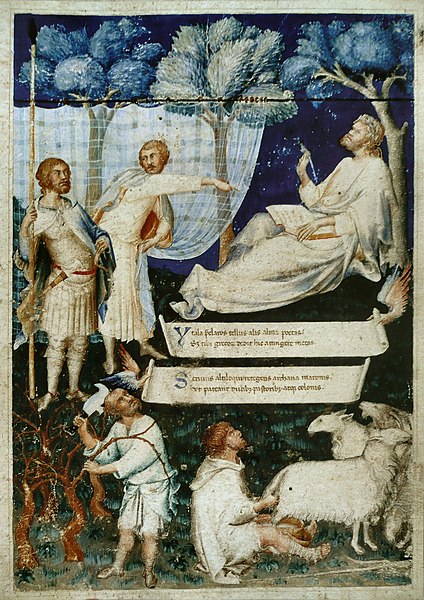
Simone Martini, Petrarchs's Virgil (title page)
Gothic style was in itself invented to enhance and explain religion in a grandiose way. Do to the face that most of the population was illiterate painting and sculpting became a way to communicate and teach Christianity to the masses. 

The first Gothic masters of art painted images that held mostly purity in spirit and intensity. Artists of the Gothic  included Cimabue (1240-1302), Duccio (1287-1318), Martini (1285-1344), and the two Lorenzetti brothers, Pietro and Ambogio. 


Innovation of the North


An international Gothic style had emerged though it divided into two different styles, North and South both had a distinctive style to their land. The south's style preludes the Renascence.

The north's style rejected the beautiful elegance that the traditional International Gothics. They produced works that for the viewer it was as if they were receiving a glimpse of heaven through painting. They placed their subjects in the midst of familiar domestic themes.

One of the earliest Northern innovators was Robert Campin (1406-1444 ). Other important artists were Jan van Eyck (1385-1464) and Rogier van der Weyen (1399-1464)

The Merode Alterpiece, Robert Campin, 1425-1428

Late Gothic Period


Mattias Grunwald , Second state of the Isenheim Altarpiece,Unterlinden Museum
The final noticeable change in the Gothic period was from the artist Mattias Grunwald( 1410-1528 ).  He exposed the truth about suffering in a harsh dark manner. The depiction of Christ on the cross ended the Gothic period. "a time of social and political upheaval, of Black Death and suffering." Next step was the Renascence."

Sources:

Christine Zibas. 2013. A Brief History of Gothic Art. [ONLINE] Available at: http://voices.yahoo.com/a-brief-history-gothic-art-4161655.html. [Accessed 08 April 13].

Wikipedia. 2013. Matthias Grünewald. [ONLINE] Available at:http://en.wikipedia.org/wiki/Matthias_Gr%C3%BCnewald. [Accessed 08 April 13].

Sunday, 7 April 2013

Modern Pointillism

Modern day Art Inspired from Pointillism (Post-Impressionism)

Miguel Endara

Miguel Endara, Hero

This design is made up of approximately 3.2 million black ink dots, using only one "Sakura Pigma Micro Pen (nib size 005, 0.20mm)"
The average amount of dots were determined by multiplying the average per dot speed( 4.25 dots per sec ) by the amount of time logged on (210 hours )

This piece to the traditional pointillism art and developed it to create an amazing realistic piece. Though the thought may not be the same the workmanship is amazing.


The making of Hero video


Clare Ellis


Clare Ellis,

Clare Ellis is an artist who intricately creates pointillism art. This work is inspired from Australian aboriginal art. She adapted and developed dot painting in her own way.

This piece is created by using acrylic on canvas. The dots add texture and depth to the piece. 

Tho not used in a scientific was in terms of colours as one of the original pointillism this .piece shows serenity in the colours chosen.


Christian Faur


Christian Faur, Experiment 5

Uses hand made crayons to create amazing works of art such as the work . He uses the crayons instead of pixels and arranges the similar to the traditional pointillism.

This piece may be the closest resemblance to the traditional counterpart.


Philip Karlberg


pointillism
Philip Karlberg

This artist uses sticks to create portraits of famous personnel. This one being Johnny Depp. He also has Lady Gaga and Jackie O


Sources:

creativebloq. 2012. Pointillism: 10 striking examples of dot art.. [ONLINE] Available at:http://www.creativebloq.com/graphic-design/pointillism-examples-dot-art-11121135. [Accessed 07 April 13].

Post- Impressionism

Post-Impressionism

About

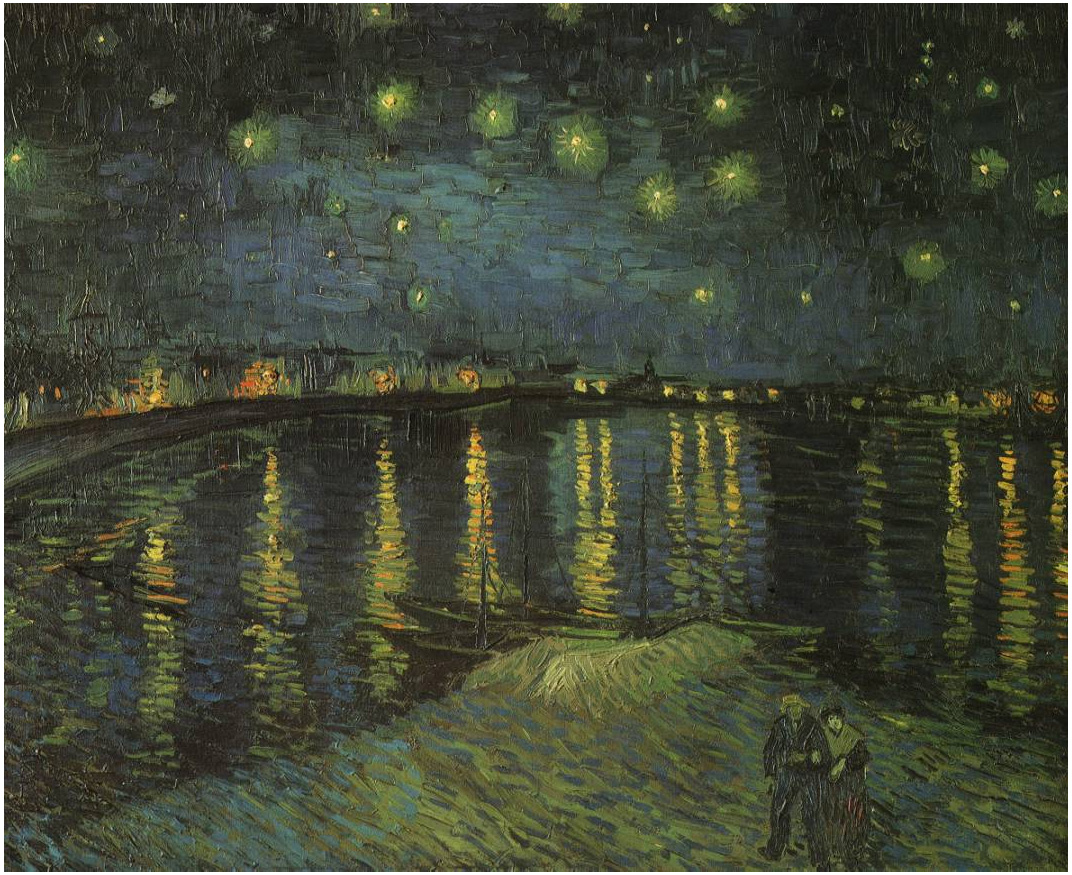
Vincent van Gogh, Starry Night Over the Rhone,
1888
Post-Impressionism is regarded as a desperate way to move on from the current Impressionist movement meaning the naturalism, and the in dept study of light and colour. They emerged around 1886 during the last(8th) exhibition of the Impressionists, embracing the various trends such as the Noe-Impressionism of Seurat and Symbolism of Gauguin.

 The name was branded by a English critic called Roger Fry in 1910 to title an exhibition in London which held works by Manet,Cezanne, Van Gogh and others.


Post-Impressionist characteristics

Contrary to the previous impressionist, the artists sought out the symbolic and personal meaning. Instead of looking at the external world hey delved into themselves for inspiration.

They turned away from the traditional light and colour and turned to abstract form and and pattern.
  • Gauguin and van Gogh created harmonious surface patterns
  • Cezannne looked to create more structure
They developed a style which was based on colours which were applied in regular, repetitive strokes.

The movement was mostly based in France but inspired artists from Europe. Artists such as Edvard Munch, Arnold Bocklin, James Ensor, Duncan Grant, Vanessa Bell, and London's Camden Town Group were key in its development or molded heavily by it .

Beginnings

The style was built upon the differences in style and personality of the artists which in the end brought down Impressionism. The term Post-Impressionism was not just a single movement but a collection of other styles trying to replace Impressionism. Many of the artists thought lowly of their rival counter parts.

George Seurat,  A Sunday Afternoon on the Island of La Grande Jatte,
,1884-86

George Seurat Is regarded as the beginning of the new trend utilizing his Pointillism technique. He ventured into the scientific aspect of colour, though artists such as Cezanne, Van Gogh and Gauguin were equally important as they differed in style and technique.


France was the pinnacle of of the movement, and artists from around the world traveled to France to absorb the rich culture and maybe join the artistic elite. This backfired greatly as the new meaning of the movement made the city life as an artistic theme obsolete, as many of the major artists were moving out of France.

Later Developments

Paul Cezanne was the one who bridged the gap between the Impressionism and the early 20th century movements. Matisse and Picasso both were inspired by him and also referred  to him as the " father of us all " his later work was based on the underlying structure, often in way that landscape is built up from simple geometric shapes. He once wrote to a fellow painter "Treat nature in terms of the cylinder, the sphere, the cone, all in perspective.

It was only in 1910 that the title Post-Impressionism was bestowed upon the movement by Roger Fry during their exhibition in the London's Grafton Galleries.

Sources:


Art Story Foundation . 2012. The Art Story. [ONLINE] Available at: http://www.theartstory.org/movement-post-impressionism.htm. [Accessed 07 April 13].


Van Gogh Gallery . 2013. Starry Night Over Rhone. [ONLINE] Available at:http://www.vangoghgallery.com/catalog/Painting/509/Starry-Night-Over-the-Rhone.html. [Accessed 07 April 13].

Friday, 5 April 2013

Claud Monet

Claud Monet


Claud Monet time line: 


Giverny. 2009. Biography of Claude Monet. [ONLINE] Available at: http://giverny.org/monet/biograph/. [Accessed 05 April 13].

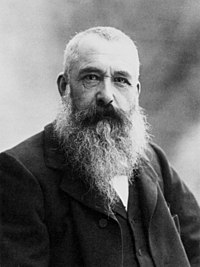
1899 Photo by Nadar


Claude Oscar Monet (November 14, 1840 - December 5, 1926) founded the french impressionist painting .. called the
"Anonymous Society of Painters, Sculptors, Print makers etc" . He became known as the most fundamental practitioner in the philosophy of the movement in terms of expressing ones perception before their natural surroundings mostly in his "plein-air" landscape painting. "plein-air" is a french expression meaning open air painting.


Early Life

Caricature of  Léon Manchon


He studied at Le Havre secondary school of the arts, he started to spread his name by drawing and selling caricatures using charcole. He generally sold them for ten - twenty franks. His former mentor was Jacques-François Ochard


On January 1857 his mother died. He was 16 when he left school, leaving to live wit his aunt Marie-Jeanne Lecadre


More of his caricatures:

Poul Webb. 2012. Art & Artists. [ONLINE] Available at: http://poulwebb.blogspot.com/2011/12/cluade-monet-caricatures.html. [Accessed 06 April 13].


Paris 


Claude Oscar Monet,
The  Woman In A Green Dress, 1866
Monet traveled to Paris to visit the Louvre. He saw other painters copy the work from their old masters, Monet on the contrary would sit by a window and paint what he saw. Monet resided in Paris for several years thus making several friends one of which was  Édouard Manet.

In 1862 he made studied under a new mentor called Charles Gleyre where he met Pierre-Auguste Renoir, Frédéric Bazille, and Alfred Sisley. This was a fundamental friendship that influenced and developed the Impressionist movement.

Monet's Camille or The Woman in the Green Dress (La Femme à la Robe Verte) which he painted in 1866 furthered developed his reputation as an artist. The woman in the painting was his future wife Camille Doncieux where she later modled for several other paintings such as The Woman in the Garden and On the Bank of the sea.


Franco-Prussian War, Impressionism, and Argenteuil


In  1872, he painted Impressions, Sunrise which consisted of the la Havre Landscape. It was exhibited in the first exhibition dedicated to impressionism. in 1874. This painting gave the movement its name.


Death


Monet died of lung cancer on December 5, 1926 at the age of 86. He wanted it to be simple and only 50 people attended. 


Sources: 

Information:

claudmonetgallery. 2012. Claud Monet. [ONLINE] Available at:http://www.claudemonetgallery.org/Impression--Sunrise.html. [Accessed 06 April 13].


Thursday, 4 April 2013

Impressionism (Origin)

Impressionism (Origin)

The Impressionist style is of painting is defined by only focusing on the general impression given off by a scene or object. The use of primary colours and small strokes to get realistic reflection of art.

Auguste Renoir, Oarsmen at Chatou, 1879


This was a major movement the the development of art later in music. This first started to develop in France   during the late 19th and early 20th century. A group of artists shared the same ideas about the technique and approach on the given theme. They  attempted to " accurately and objectively record visual reality in terms of transient effects of light and colour"


The major Impressionist painters were : Claud Monet, Pierre Auguste Roenoir, Camille Pisarro, Alfred Sisley, Berthe Morisot, Amand Guillaumin and Frederic Bazille. The artists worked together further influencing each other, exhibiting together and interdependently.

They called themselves Anonymous Society of Painters, Sculptors, Printmakers, etc.

Also one of the main influence of Monet and other members of the group was a painter called Edouard Manet which later he adopted the Impressionist approach in about 1873.

Origin of the Word


It was derived from the words of a critique called  Louis Leroy. He criticized Cezanne and Monet only revealing the most harshest critiques commenting that their works are only unfinished sketches. He used the word "Impressionist" from Claude Monet's painting titled "Impression sunrise"

Impression Sunrise, Claude Monet, 1873.
His exact words were : " Impression—I was certain of it. I was just telling myself that, since I was impressed, there had to be some impression in it ... and what freedom, what ease of workmanship! wallpaper in its embryonic state is more finished than that seascape."


Despite being frowned upon at first, in a short time the term "Impressionists" was accepted by the general public. Both paintings and artists were becoming more and more popular even though the style has a more stylistic and mood driven sources than the title implies.

Sites:

Impressionism. 2012. Impressionism in the Visual Arts What is Impressionism?. [ONLINE] Available at: http://www.impressionism.org/. [Accessed 04 April 13].

Nicolas Pioch. 2006. Impressionism. [ONLINE] Available at:http://www.ibiblio.org/wm/paint/glo/impressionism/. [Accessed 04 April 13].

Tuesday, 5 March 2013

Romanticism

Romanticism

(Beginning in the late 18th century and lasting until the middle of the 19th ).

The Background


The industrial period started developing  around the 18th century. It started and flourished in England, later developing in France and America. Villagers moved from farms and the country side to the city to find jobs in factories. Rapid growth developed cities that were very dirty and crowded with the poor living in inhumane places and the sky blackened with soot.


At the same time there was an opposite reaction against the Industrial age. The Philosophy of the Enlightenment which emphasized science, empirical evidence and rational thought above all was beginning to be frowned upon. Romantics  challenged the idea that reason was the one path to truth and that judging it was not enough in understanding the mysteries of life.

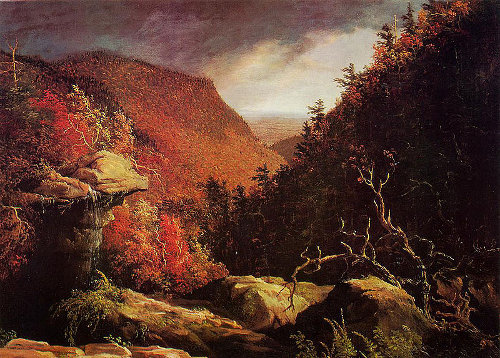
The Clove Catskills, by Thomas Cole, 1827

Nature was one of the main subjects in this period as it provided a sense of self discovery and spiritual learning an place in which mysteries could be reviled to the mind of man. The Artists produced work containing deep feeling, spirituality and free expression . They used this as a form of rebellion against the effects of industrialization and prioritized the human beings which they believed to have infinite, godlike potential.


Artists in this period tried to capture their ideas in their work. They differed from the path of the Neo-classicists which was characterized by their rationalism and rules-driven orderliness. Somewhat like Baroque  artists, Romantic artists tried to achieve an emotional response in those who viewed art. Though instead of inspiring faith as the Baroque, most looked to evoke nostalgia, pastoral life, the stirring of life's mystery, and the sense of power and grandeur of nature.

In this period art also depicts the romantic ideal of nationalism.


Sources:

Art of Manliness. 2010. The Basics of Art: The Romantic Period. [ONLINE] Available at: http://www.artofmanliness.com/2011/03/03/the-basics-of-art-the-romantic-period/. [Accessed 04 April 13]
       
Paul Brians. 1998. Romanticism. [ONLINE] Available at:http://public.wsu.edu/~brians/hum_303/romanticism.html. [Accessed 04 April 13].          http://www.metmuseum.org/toah/works-of-art/03.30